
Singapore traffic rules · demerit points
One red light, licence gone: the 12-point math that ends new drivers’ licences from 1 January 2027
Traffic Police has cut a probationary driver’s demerit allowance from 13 points to 12. Three everyday offences, including running a red light, already carry 12 points on their own.
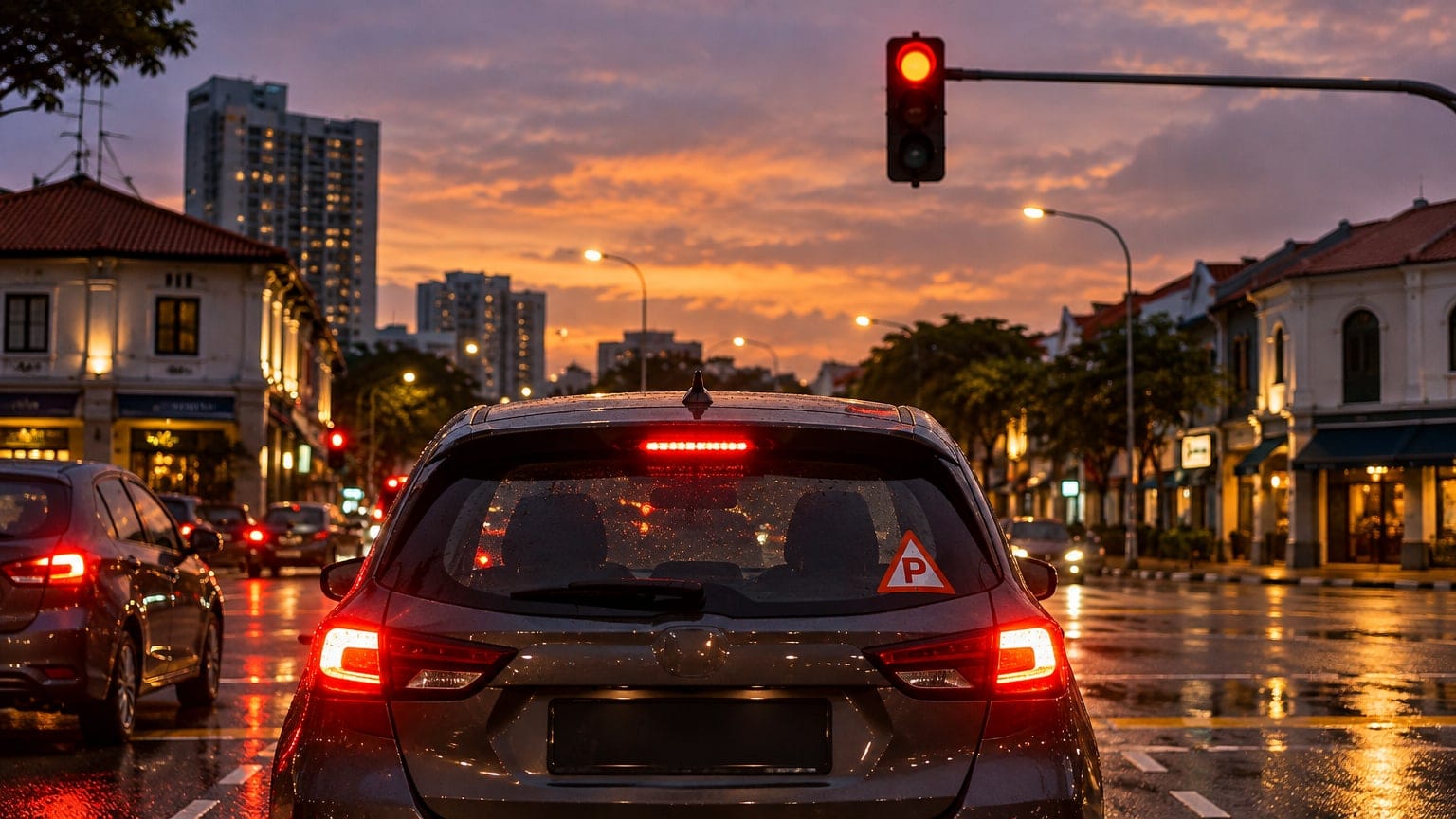
From 1 January 2027, a probationary driver in Singapore who runs a single red light will lose their driving licence. The offence carries exactly 12 demerit points, and the revised Driver Improvement Points System (DIPS) revokes a probationary licence at 12 or more points, down from 13. The same is true of driving while holding a mobile phone, and of one speeding ticket for going 31 to 40 km/h over the limit.
Until now, a lone red-light ticket was survivable even for a brand-new driver: 12 points sat one below the 13-point revocation line. The threshold cut removes that one-point cushion, and it lands on top of the harsher speeding penalty table that has been in force since 1 January 2026. Run together, the two changes produce a regime with no margin for error during a new driver’s first year: one moderate mistake ends the licence entirely, and the driver starts the whole licensing process over.
Every learner who passes the practical test from now on enters this regime, and so does every P-plate driver still inside their probationary period when the clock strikes 2027.
Two announcements, seven months apart
The new regime comes from two announcements that were made and reported separately. On 19 December 2025, the Ministry of Home Affairs confirmed that from 1 January 2026, speeding would attract more demerit points and higher composition sums: six points for going up to 20 km/h over the limit (up from four), eight for 21 to 30 over (up from six), and 12 for 31 to 40 over (up from eight).
Seven months later, on 31 July 2026, Traffic Police announced the tightening of DIPS itself: from 1 January 2027, non-probationary drivers face first suspension at 18 points instead of 24, and probationary drivers face revocation at 12 instead of 13. Coverage by The Straits Times, CNA and Motorist.sg framed the change for motorists in general. The one worked example in Motorist’s explainer used a non-probationary driver; the probationary cohort, which faces revocation, received a single bullet.
That bullet is the one aimed at new drivers. Suspension, which applies to experienced drivers, is a pause: the licence waits while the suspension runs. Probationary drivers instead face revocation: the licence becomes invalid, and the only way back is to be relicensed, which means taking the tests again.
The single offences that already reach 12
The demerit schedule in force since 1 January 2026 (set out in the DIPS Rules and published by SPF) contains three offences that carry 12 points on their own, which from 2027 is exactly the probationary revocation threshold. No second offence is required.
Demerit points for common offences, measured against the new-driver threshold
The zone multiplier applies to red lights and phone use too: beat a red light inside a School Zone, Silver Zone or Friendly Street and the score is 14. Speeding more than 40 km/h over the limit is no longer a composition matter at all: it carries 18 points and prosecution in court.
And the enforcement pressure behind these numbers is rising. Traffic Police recorded 253,550 speeding violations in 2025, up 25.9% from 201,358 the year before, which is about 695 drivers caught per day. Mobile-phone violations rose 39.1% to 4,193, and accidents caused by red-light running jumped from 96 to 122. TP has also said it will activate speed enforcement in more red-light cameras. The offences most likely to end a probationary licence are precisely the ones being chased hardest.
How a speeding ticket crossed the line
The 2026 penalty revision pushed every speeding band up by 50% or more. The band that crossed the probationary threshold was the 31–40 km/h bracket, which tripled from 8 points to 12.
Speeding demerit points, 2025 vs 2026, by how far over the limit
The combinations: where 2026 forgave and 2027 won’t
Most new drivers will not run a red light. The more realistic path to 12 points is stacking smaller offences during the probationary year, and there the one-point threshold cut decides the outcome.
Two offences in your probationary year: combined score
3 pts
seat belt
4 pts
give-way / lines
6 pts
≤20 over
8 pts
21–30 over
12 pts
red light / phone / 31–40 over
3 pts
seat belt
4 pts
give-way / lines
6 pts
≤20 over
8 pts
21–30 over
12 pts
red light / phone / 31–40 over
The cleanest example of what changed is the double row of 6-point offences. Under the current rules, a new driver caught twice going up to 20 km/h over accumulates 12 points and keeps driving: 12 is below the 13-point line. From 2027 the identical record triggers revocation. The threshold moved so that the most ordinary repeat-offence scenario flips from survivable to fatal.
There is a built-in warning, if you know to watch for it. Under the Road Traffic (New Drivers) Rules, a new driver receives a written warning upon reaching 6 points, and Traffic Police must issue a 14-day show-cause notice before revocation. In practice, the first ticket of your driving life likely arrives with a letter telling you that the next moderate mistake will cost you the licence.
The harshest deal in the system, with the smallest cushion
Compare how the revised DIPS treats the two groups. Probationary drivers face the more severe consequence, receive the smaller transition discount, and have access to none of the mitigation tools.
Probationary drivers vs everyone else, from 1 January 2027
| Probationary (P-plate) drivers | Non-probationary drivers | |
|---|---|---|
| Trigger | 12 or more points within the one-year probationary period | 18 or more points within 24 months |
| Outcome | Licence revoked: it becomes invalid and the driver must be relicensed to drive again | Licence suspended: 4 months for a first suspension, reducible to 6 weeks via the DIPS Retraining Course |
| One-time point deduction on 1 Jan 2027 | Up to 1 point | Up to 6 points |
| Safe Driving Course (4-point wipe) | Never available: SPF eligibility rules exclude probationary drivers, and the course is discontinued from 2027 regardless | Discontinued from 2027; 2026 offer letters must be completed by 31 December 2026 |
| Points wiped by clean driving | 12 months with no scheduled offence clears prior points, but probation itself lasts 12 months: the year must simply be clean | Same 12-month clean-period rule |
What revocation costs
From one offence to starting over
Driving guides covering the probationary rules describe revocation as wiping the licence and requiring the driver to re-apply and pass the theory and practical tests from scratch, and SPF points revoked drivers to an appeal process that exists precisely because the consequence is so heavy. If you hold a converted foreign licence rather than a Singapore QDL, note that a separate regime applies: 13 or more points within 12 months of conversion can bring a prohibition order barring you from driving any class of vehicle in Singapore for 12 months.
Why Traffic Police did this
The tightening is a response to the deadliest year on Singapore’s roads in a decade. Road fatalities rose to 149 in 2025, a 10-year high, up from 142 in 2024, and injuries rose 6.6% to 9,955. Traffic Police said the DIPS revision is meant to deter violations and keep errant motorists off the roads longer, complementing legislative changes MHA has tabled in Parliament.
“It doesn’t have to be a boy racer with golden hair. It doesn’t have to be a car driver with a string of antecedents and suspension records. It can be somebody with a clean record.”
That logic is aimed at new drivers: the first year of solo driving is where inattention is most likely, and under the new rules a single lapse costs the licence.
How to protect your licence, before and after you pass
- Learn the penalty table as part of your theory study. The BTT and FTT question banks are being updated to reflect the new thresholds, and the speeding bands are exactly the kind of number question the tests love. Knowing “31–40 over = 12 points” is both an exam answer and a survival fact.
- Know the default speed limits. Singapore’s default limits are generally 50 km/h on ordinary roads and 80–90 km/h on expressways, unless signed otherwise. The 31–40 band that ends a probationary licence begins at 81 km/h in a 50 zone.
- Watch for the zone signs. School Zones front schools, Silver Zones sit in estates with many senior residents, and Friendly Streets are signed stretches near markets, hawker centres and MRT stations. Specified offences there carry 2 extra points and S$100 more in composition.
- Never hold the phone while driving, including at a standstill in traffic. Twelve points, instant revocation from 2027.
- If a ticket arrives, check your balance. You can view your demerit points through SPF e-services and your Digital Driving Licence via Singpass. A 6-point warning letter means the next moderate offence is the last one you can afford.
- One-time grace: if you already have points when 2027 starts, up to one point is deducted from your balance as of 31 December 2026. Do not plan around it; it does not apply to offences committed in 2027.
From 1 January 2027, the system stops forgiving the difference between “carelessly” and “almost carefully”.
Sources
- Singapore Police Force, Tightening of the Driver Improvement Points System (DIPS), 31 July 2026 (thresholds, suspension periods, one-time deduction, SDC discontinuation).
- Ministry of Home Affairs, Enhanced Penalties for Speeding Offences, 19 December 2025 (speeding point table, zone and Friendly Streets enhancements, effective 1 January 2026).
- Singapore Police Force, Penalties for Traffic Offences and Driver Improvement Points System pages (offence points, composition fines, probationary rules).
- Road Traffic (Driver Improvement Points System) Rules, Singapore Statutes Online (scheduled offences and the +2 zone rule, S 808/2025 in force from 1 January 2026; prohibition orders for foreign licence holders).
- The Straits Times, Road traffic fatalities hit 10-year high of 149 in 2025, February 2026 (fatality, speeding, red-light and mobile-phone statistics).
- The Straits Times, Stricter demerit points system for motorists from 2027; CNA, First licence suspension at 18 demerit points under stricter rules; Motorist.sg, TP lowers demerit point thresholds from 1 Jan 2027.
- Recording Law, Demerit Points in Singapore: The DIPS Thresholds (legal basis in the Road Traffic (New Drivers) Rules, 6-point warning, 14-day show-cause notice); SGDrivingTheory, Stricter Demerit Points System (DIPS) 2027 (restart consequences for revoked licences).
Rules and figures verified as of 6 November 2026 against the primary announcements listed above. Penalty amounts and thresholds can change; confirm current rules with the Singapore Police Force before relying on them. This article is general information, not legal advice.